


Electrical Voltage and Current Unbalance
What is unbalanced or imbalanced voltage? Definition of voltage unbalance according to IEC is as the ratio of negative sequence voltage to the positive sequence voltage. There is an inequality on phase voltages. Imbalanced or unbalanced current definition is as the maximum deviation of any current phase from the average current, divided by the average current, often expressed as a percentage. This article will briefly discuss the root causes, impacts and solutions for handling voltage and current imbalance problems in the electrical system. Unbalanced voltage or current is one of the most common power quality problems encountered. —Omazaki Consultant is a consultant that provides electrical power quality audit, assessment, measurement, inspection, verification, and monitoring services for both commercial and industrial facilities. If you are looking for electrical consultants who provide voltage and current unbalance or imbalance problem solving and solution, please contact us by sending an email to cs@omazaki.co.id or by filling in the form in contact
———————————————
Definition of Voltage Unbalance
IEC
According to IEC 60034-26, voltage unbalance factor (VUF or Kv) is the ratio of the negative-sequence voltage (V2) to the positive-sequence voltage (V1). This definition ignores the phase angle.

The three phase voltages can be mathematically expressed as a sum of positive, negative and zero sequence components. Positive sequence voltage creates flux in the direction that the motor is intended to rotate and negative sequence voltages rotate in the opposite direction. This creates flux in the opposite direction, however, since the positive sequence voltages are always much larger than the negative sequence voltages the direction of motor rotation is not aected.
IEC 60034-1 imposes a 1% negative phase sequence voltage limit on the supply feeding machines.
IEEE
The IEEE uses the same definition of voltage unbalance as NEMA, the only difference being that the IEEE uses phase voltages rather than line-to-line voltages.
NEMA (National Equipment Manufacturer’s Association) Definition: The NEMA definition of voltage unbalance, also known as the line voltage unbalance rate (LVUR), is given by:

The IEEE definition of unbalanced voltage, also known as the phase voltage unbalance rate (PVUR), is given by

———————————————
The Causes of Voltage Unbalance
Common causes of the voltage unbalance are:
Source form Power Supply
- Unbalanced or unstable utility supply
- Asymmetrical transformer winding impedance
- Open wye and open delta transformer banks
- Unbalance of power supply
- The impedance of the power supply conductors is not the same.
- Unbalanced distribution / single phase load (lighting)
- The taping on the transformer is not the same
Source form User’s System
- Load asymmetry
- Asymmetrical transformer winding impedance
- Uneven distribution of single-phase loads (if the loads are not uniformly spread among the three phases)
- Unbalanced and overloaded equipment
- High impedance connections (e.g., bad or loose contacts)
- Faulty operation of power factor correction equipment
- Unbalanced transformer bank supplying a three-phase load that is too large for the bank
- Unidentified single-phase to ground faults
- There is an open delta in the transformer-bank
- There is an open phase in the distribution transformer primary
- There is a fault or ground in the power transformer
- There is a single phase transformer in the system
- There is a fuse-blown in 3 phases in the capacitor bank (capacitor for power factor improvement)
- Heavy reactive single phase load. For example: welding machine.
———————————————
 The Effect of Voltage and Current Unbalance In Industrial Application
- Causes current unbalance
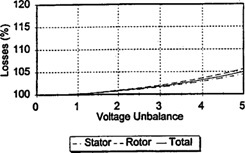
- The power system will incur more losses and heating effects
- Motor overheating and premature motor failure –Winding insulation life is reduced by one-half for each 10°C increase in operating temperature
- Degrades the performance and shortens the life of a three-phase motor
- Reduction in the net torque and speed, and the possibility of speed and torque pulsations and increased motor noise
- The negative sequence component in the unbalanced voltages generates large negative sequence currents due to the low negative sequence impedance, which increases the machine losses and temperatures
- Unbalanced currents lead to torque pulsations, increased vibrations and mechanical stresses, increased losses resulting in lower efficiency, and motor overheating, which reduces winding insulation life.
———————————————
Technique to Mitigate Voltage Imbalance
Mitigation Techniques in a Power Supply System
- Proper selection of distribution transformers
- Voltage unbalance in ac supply systems can be corrected by means of a shunt con- nected thrysitor-controlled static VAR compensato
- Install active line conditioner
Mitigation Techniques in a User Facility
- Check and update electrical system single-line diagram (SLD) to verify that single-phase loads are uniformly distributed
- Changing the system configuration
———————————————
 Contact Omazaki Consultant if you are looking for consultant who provides voltage and current unbalance problem solving engineering consulting service for your existing electrical industrial system and facility.
———————————————
Related Articles
- Electrical Power System Study
- Voltage Imbalance (Unbalance) Study
- Voltage Drop Study & Analysis
- Power Quality Measurement & Monitoring
———————————————
References
- IEEE Std 1459 IEEE Standard Definitions for the Measurement of Electric Power Quantities Under Sinusoidal, Nonsinusoidal, Balanced, or Unbalanced Conditions
- IEEE Std 1159 IEEE Recommended Practice for Monitoring Electric Power Quality
———————————————